
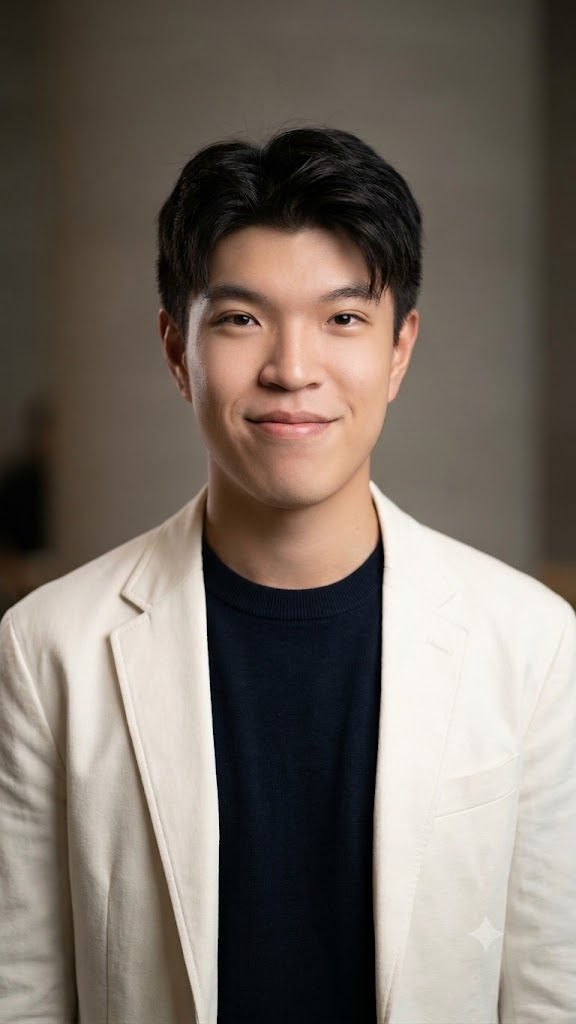
Biography
Ruofan Lin serves as a Digital Humanities Specialist and Research Fellow at the HEPA Lab. His multidisciplinary scholarship spans educational psychology, organizational behavior, data-driven management, and social responsibility. Lin has co-authored several empirical studies published in academic journals, including "Understanding High School Mathematics Learning Through Grit and Achievement Goals: An Empirical Study" and "A Multidimensional Analysis of Social Responsibility Among Nursing College Students: A Perspective Based on Educational Environment and Personal Traits." His research leverages digital and quantitative methods to examine how personal traits, learning environments, and institutional support systems shape human development, performance, and social accountability. Additionally, he actively contributes to the global academic community as a peer reviewer for scholarly journals, including SiRad: Pelita Wawasan.
Research Interests
Digital Humanities & Quantitative Analytics; Educational & Behavioral Psychology; Business Administration; Organizational Behavior
Selected Publications
- Wu, Y., Lin, R., Kong, W., Lv, T., Chen, Y., & Wu, J. (2026). Associations Between Fitness-Related Social Media Usage Motivations and Fitness Management Behaviors Among University Students. Computational Media and Immersive Technologies, 1(1), 77–98. Link
- Wu, J., Wu, Y., Lin Ruofan, Chen Y., Guo, S., Lv, T., & Kong, W. (2026). Generative AI-assisted instruction and college students’ academic self-efficacy, computational thinking, and critical thinking disposition: A six-week pretest-posttest study. Journal of Vocational, Informatics and Computer Education, 4(3), 211–226. Link
- W. Y., Lin, R., & K. W. (2026). Building a Sustainable Educational Ecology for Arts Major Students: Practice-Based Model Development of a Counselor-Led Mental Health Support Model. Frontiers in Educational Innovation and Research, 2(3), 90-103. Link
- W. Y., & Lin, R. (2026). Understanding high school mathematics learning through grit and achievement goals: An empirical study. Journal of Advances in Social Sciences, 2(4), 22-32. Link
- W. Y. & K. W. & Lin, Ruofan. (2025). The Impact of OECD on South Korean Education Policy: Balancing Global Governance and National Demand (1993-2022). Global Review of Humanities, Arts, and Society. 1. 41-64. Link
- W. Y., Li, J., K. W. & Lin, R. (2025). Happiness Predicts academic achievement: A Longitudinal Empirical Analysis of Subjective Well-Being and Academic Performance Among College Students. (2025). New Horizon of Education, 1(1), 23-37. Link
- W. Y., K. W., Lv, T., Li, J., & Lin, R. (2024). Social Support and Subjective Well-Being in Chinese Art Students: The Moderating Effect of Positive Thinking. The Journal of Social Science and Humanities, 1(1), 8-25. Link
- W. Y., Lin, R., K. W., & Xi, X. (2024). Between Comfort and Challenge: The Role of Social Support in Shaping College Students’ Happiness and Stress. Journal of Educational Theory and Practice, 1(4), 15–23. Link
- W. Y., K. W., Lv, T., Lin, R., Li, J., Xi, X., & Liu, B. (2025). The Relationship Between Anxiety and Academic Achievement of Middle School Students in Wuhan, Hubei Province, China. ICCK Transactions on Social Statistics and Computing, 2(1), 47–54. Link
- W. Y., K. W., & Lin, R. (2025). A Multidimensional Analysis of Social Responsibility Among Nursing College Students: A Perspective Based on Educational Environment and Personal Traits. Frontiers in Educational Innovation and Research, 1(3), 71–80. Link
- W., K., & 林若凡 (2025). 小微企业所有者数字化转型接受度与成果:内外部因素的综合影响. 创新创业学刊, 1(1), 34-42. Link
- W., C., K., & 林若凡 (2026). 基于心理资源理论的高职艺术设计学生学业倦怠缓解路径研究. 现代教育与教学创新, 1(2), 32-38. Link
- W., 林若凡 & L. (2025). 护理专业大学生社会责任感的多维度分析:基于教育环境与个人特质的视角. 医学与健康科学研究, 1(1), 12–21. Link
- W., L., 林若凡, L., C. (2026). 民办高校学生事务管理与心理健康教育一体化建设研究. 金琅学术出版社. ISBN: 9786630201154 Link
- Monograph W., L., 林若凡, K., C. (2026). 民办高校学生事务管理与心理健康教育一体化建设研究. 金琅学术出版社. ISBN: 9786630201154 Link